What Are the Top Miniature Bearing Types in 2026?
A miniature bearing may be only a few millimeters wide, yet it can determine whether a dental handpiece runs smoothly or a tiny motor overheats. The right type depends on load direction, speed, available space, lubrication, and the cost of failure. Common choices include deep-groove ball, angular-contact, thrust, and needle bearings, alongside miniature hybrid-ceramic designs. Small does not mean simple.
Grand View Research estimated the global bearing market at about US$132.3 billion in 2023 and projected growth through 2030. That figure covers bearings broadly, not miniature bearings alone, so it should not be read as a miniature-market forecast. Still, it points to the wider demand shaping precision components. In practical selection, catalog ratings and test conditions matter more than a market headline. ISO 281 provides a recognized framework for calculating rolling-bearing life, but actual service life also depends on installation, contamination, and lubrication.
This guide compares the leading miniature bearing types by load capacity, speed, stiffness, and typical application. It also considers trade-offs that are easy to miss: a shield can limit debris entry, but it does not correct poor alignment; ceramic rolling elements can reduce weight, but they are not automatically the best choice. A useful expert quotation would help sharpen this discussion. However, no source material was supplied to verify a named specialist’s exact words, so none is invented here. That omission is deliberate—and worth revisiting once a reliable interview or publication is available.
Miniature Bearing Basics: Common Metric Bore Sizes Range from 1–10 mm
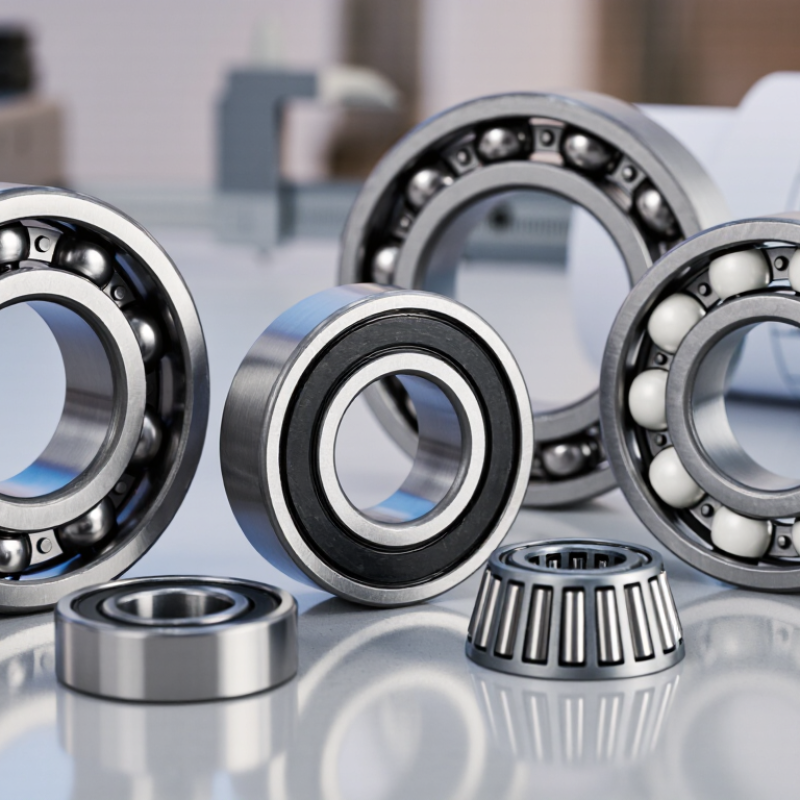
Miniature bearings serve compact mechanisms where space, weight, and smooth rotation matter. Common metric bore sizes range from 1 to 10 mm, though availability varies by bearing design. The bore is the opening for the shaft, not the bearing’s outside diameter. A 5 mm bore is intended for a nominal 5 mm shaft, but actual fit depends on tolerances. Measure the shaft carefully; a small mismatch can cause looseness or difficult assembly.
Deep-groove ball bearings are a common choice for radial loads and moderate speeds. Angular-contact types can handle combined radial and axial loads, while miniature thrust bearings support axial loads. The right type depends on the force direction, speed, lubrication, and available space. A 2 mm bore may suit a tiny instrument, while a 10 mm bore can fit a sturdier compact assembly. Bigger is not automatically better.
Tips: Check the shaft diameter, housing space, and load before choosing a bore size. Keep the bearing clean during installation, and press on the fitted ring rather than the opposite one. Even careful measurements can miss a tolerance issue. If fit remains uncertain, test with the actual shaft and housing before final assembly.
Deep-Groove Ball Bearings: Support Radial and Bidirectional Axial Loads
Deep-groove ball bearings are a common choice when a miniature assembly needs radial support and axial positioning in both directions. Their balls run in continuous grooves, allowing them to carry loads from a rotating shaft as well as moderate side thrust. The exact capacity depends on bearing size, internal clearance, speed, and lubrication. They are not a substitute for a thrust bearing when axial loads are heavy.
Small does not mean simple. In a compact motor, for example, a bearing may sit close to a warm housing while supporting a shaft that turns thousands of times per minute. A tight housing fit can reduce internal clearance, so dimensions and mounting tolerances deserve attention. Too much clearance can also invite vibration or noise. Fit matters. Seals help keep dust out, but contact seals can add friction; open designs need cleaner surroundings and suitable lubrication. A detail often overlooked is alignment: even a capable deep-groove bearing may wear early if the shaft and housing are not coaxial. Choosing one by outside diameter alone is tempting, but it leaves important questions unanswered.
Angular-Contact Bearings: 15°–40° Contact Angles Handle Combined Loads
Angular-contact miniature bearings use a tilted raceway contact path to carry radial and axial loads together. Contact angles commonly span 15° to 40°, but the right choice depends on load direction, speed, and stiffness requirements. A 15° angle generally suits stronger radial support and higher-speed designs; a larger angle can support greater axial load. Small angle. Real trade-offs. A spindle carrying a side load, for example, may need a matched pair so the bearings resist thrust in both directions. Mounting preload matters, too: excessive preload can raise heat and shorten service life.
Selection should follow measured loads, not angle alone. ISO 281:2007 defines basic rating life for ball bearings as L10 = (C/P)³ million revolutions, where C is basic dynamic load rating and P is equivalent dynamic load. L10 represents a life that 90% of a sufficiently large group is expected to reach or exceed under the standard’s assumptions. It is a useful comparison, not a guarantee for a specific assembly. Misalignment, lubrication, contamination, and fit can change real results. In miniature systems, a tiny housing error can matter; that detail is easy to underestimate. Check the load calculation, operating temperature, and paired-bearing arrangement before locking in a 15°–40° contact angle.
Thrust Bearings: Carry Axial Loads, Not Radial Loads
What Are the Top Miniature Bearing Types in 2026?
Thrust Bearings: Carry Axial Loads, Not Radial Loads
A thrust bearing handles force along a shaft’s axis. It is not designed to support radial loads pushing across the shaft. In a small actuator, for example, a thrust bearing can manage pressure from a screw pressing against a washer. A separate radial bearing should guide the shaft. Mixing these jobs can cause excess friction, heat, and early wear. Easy to overlook.
Common miniature options include ball, needle-roller, and cylindrical-roller thrust bearings. Ball types suit lighter loads and higher speeds; rollers generally carry heavier axial loads in less space. Check the specified load direction, speed, lubrication, and fit before choosing. Even slight misalignment can concentrate contact on one edge. That detail matters.
The market context is broad, not miniature-specific: Grand View Research estimated the global bearing market at USD 132.7 billion in 2023 and forecast a 9.1% compound annual growth rate from 2024 to 2030. This figure does not predict demand for miniature thrust bearings alone. For engineering selection, ISO 281 provides a framework for calculating rolling-bearing rating life; actual service life still depends on installation, lubrication, and operating conditions. A neat calculation is not a guarantee.
Hybrid Ceramic Bearings: Si₃N₄ Balls Have a Density of About 3.2 g/cm³ vs Steel’s 7.8 g/cm³
What Are the Top Miniature Bearing Types in 2026?
Hybrid ceramic bearings pair silicon nitride balls with steel rings. Si₃N₄ has a density of about 3.2 g/cm³, compared with roughly 7.8 g/cm³ for bearing steel. For balls of equal size, that means ceramic balls weigh about 59% less. A useful difference. It does not make the whole bearing 59% lighter, because the rings remain steel.
Lower ball mass can reduce centrifugal forces as a bearing spins quickly. In a compact motor spindle, that may help limit heat and friction, especially at high speeds. But the result depends on the design, lubrication, fit, and operating load. Density alone cannot predict performance. It is an easy number to overvalue.
Silicon nitride is hard and wear-resistant, yet it is less tolerant of impact than steel. Poor alignment or sudden loading can still damage a bearing. For a steady, high-speed application, a hybrid design may be worth evaluating. For shock loads or cost-sensitive equipment, a full-steel bearing may be the more practical choice. Check the operating conditions, not just the material label. The comparison is useful, but incomplete.