Welcome to our websites!

2026 Top Rear End Bearing Manufacturers and Suppliers

The 2026 Top Rear End Bearing Manufacturers and Suppliers market reflects a demanding shift in automotive and industrial drivetrain requirements. Rear End Bearing performance directly affects axle stability, noise control, rolling resistance, and service life. In practical terms, a bearing must survive heat, shock loads, contaminated lubricant, and repeated braking cycles.

Recent industry research supports this broader demand. Grand View Research identifies automotive bearings as a growing global market, supported by vehicle production, replacement demand, and advanced manufacturing. MarketsandMarkets also highlights stronger requirements for lightweight components, predictive maintenance, and higher efficiency across drivetrain systems. These reports do not always separate rear axle bearings from other automotive bearing categories. That limitation matters.

SKF and Timken annual reports describe continuing investment in engineered bearings, digital monitoring, material development, and customer-specific solutions. Their published technical resources show why supplier evaluation should extend beyond price. Buyers should examine dynamic load ratings, internal clearance, heat treatment, seal design, grease compatibility, and dimensional consistency. ISO 9001 certification is useful, while IATF 16949 can provide stronger evidence for automotive production controls.

Small details matter.

A reliable supplier should provide inspection records, batch traceability, drawing control, and realistic delivery data. Field experience also deserves attention. A bearing that performs well on a test bench may behave differently inside a heavily loaded axle housing. Some online comparisons overlook this point. They may also confuse wheel bearings, differential bearings, and pinion bearings.

This guide compares leading manufacturers and suppliers through product quality, engineering capability, certification, aftermarket support, and global availability. The ranking is not absolute. Application conditions, vehicle design, and regional service networks can change the best choice.
2026 Top Rear End Bearing Manufacturers and Suppliers

Rear End Bearings: Definition, Function, and Importance

Rear end bearings are precision components used in a vehicle’s rear axle or differential assembly. They support axle shafts, carrier assemblies, and related gears. Their main task is to keep rotating parts aligned under changing loads.

A bearing separates moving surfaces with rolling elements and a carefully controlled lubricant film. This reduces friction, heat, and metal contact.

Small parts. Serious responsibility.

During acceleration, cornering, and braking, rear end bearings handle radial and axial forces. Tapered roller bearings often manage combined loads effectively. Proper adjustment also controls shaft movement and gear alignment.

Excessive clearance may create rumbling, vibration, or uneven gear wear. Excessive preload can generate heat and shorten service life.

These details require measured procedures, not guesswork.

Inspection usually begins with sound, temperature, and play. A low growl may change when the vehicle turns. Dark or metallic lubricant can indicate internal wear, although contamination may distort the evidence.

Technicians should inspect seals, races, rollers, and mounting surfaces before replacing parts. Clean tools matter. So does correct torque.

Installation errors remain common, even in experienced workshops. I have found that a quiet test drive does not always prove a bearing is healthy.

Load, temperature, and road speed can reveal problems later.

Reliable maintenance records and manufacturer-specified measurements provide stronger evidence than intuition alone.

Main Types of Rear End Bearings and Their Applications

Main Types of Rear End Bearings and Their Applications

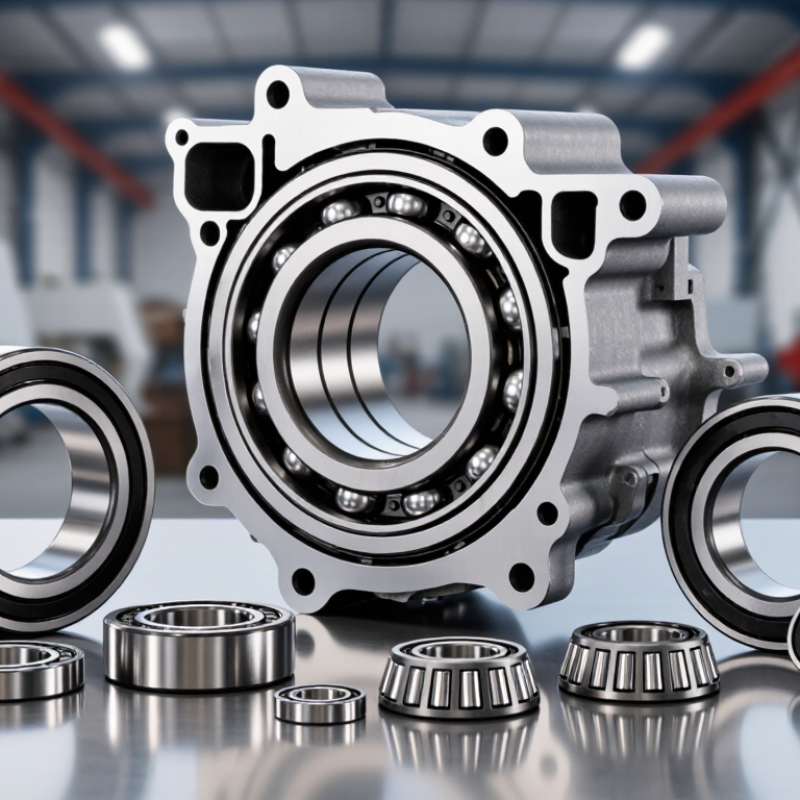
Rear end bearings support differential gears, axle shafts, and wheel hubs under combined radial and axial loads. Tapered roller bearings suit live axles because their angled rollers control end play. They perform well under cornering forces and uneven road surfaces. Cylindrical roller bearings handle high radial loads with low sliding resistance. They are common in heavy-duty axle assemblies. Ball bearings fit lighter rear hubs where speed, compact size, and moderate loads matter more. Needle bearings work inside tight differential spaces, although their smaller contact area demands careful lubrication.

Application choice is becoming more important as vehicle designs change. The International Energy Agency reported over 17 million electric car sales in 2024, representing more than 20% of global sales. Electric drivetrains deliver instant torque, which can increase shock loads through the final drive. This makes surface hardness, cage stability, and seal performance critical. Research and Markets also identifies growing demand for automotive bearings through 2030, driven by vehicle production and electrification. Yet market forecasts are not field evidence. Real durability still depends on preload, lubricant cleanliness, housing alignment, and thermal cycling.

In service work, a rough humming noise often points to raceway damage. A magnetic drain plug can reveal metallic debris early. Heat marks near the seal deserve attention. Some failures remain difficult to diagnose because tire noise masks bearing noise. That is an imperfect lesson. Selecting by load rating alone can still produce premature failure.

2026 Top Rear End Bearing Manufacturers and Suppliers - Main Types of Rear End Bearings and Their Applications

Bearing Type Typical Design Primary Load Capability Common Rear-End Location Typical Applications Key Advantages Main Considerations
Tapered Roller Bearing Inner ring, outer ring, tapered rollers, and cage High radial and axial loads, including combined loads Differential carrier, pinion support, and axle assemblies Passenger vehicles, light trucks, heavy-duty axles, and off-road drivetrains High load capacity, controlled axial positioning, and robust durability Requires correct preload, alignment, lubrication, and installation adjustment
Deep-Groove Ball Bearing Single-row ball bearing with deep raceway grooves Moderate radial loads and limited axial loads in both directions Auxiliary shafts, smaller axle components, and accessory drives Light-duty vehicles, utility equipment, electric drive units, and compact gearboxes Low friction, high-speed capability, simple installation, and broad availability Less suitable for very high shock loads or substantial axial positioning loads
Cylindrical Roller Bearing Cylindrical rollers with flanged or separable raceway arrangements Very high radial loads; axial capacity depends on flange design High-capacity axle shafts and selected differential supports Heavy commercial vehicles, industrial axles, and high-load transmission systems High radial stiffness, strong shock-load resistance, and good load distribution Needs accurate shaft and housing alignment; axial location may require another bearing
Needle Roller Bearing Long, small-diameter rollers with a high length-to-diameter ratio High radial loads within a compact cross-section Compact differential mechanisms, joints, and auxiliary drivetrain locations Space-constrained automotive assemblies, transfer systems, and industrial mechanisms Small radial section, low weight, and efficient use of limited installation space Sensitive to misalignment, contamination, insufficient lubrication, and shaft surface quality
Spherical Roller Bearing Two rows of barrel-shaped rollers with a spherical outer raceway Very high radial loads and moderate axial loads Large industrial axle housings and heavy-duty rotating equipment Mining vehicles, construction equipment, industrial gear drives, and heavy machinery Accommodates shaft deflection and misalignment while carrying heavy loads Larger, heavier, and generally less suited to high-speed compact automotive applications
Angular Contact Ball Bearing Ball-and-raceway contact angle designed for combined loading Radial loads combined with significant one-direction or paired axial loads Pinion support and precision drivetrain shaft locations Performance axles, precision gearboxes, electric drive units, and high-speed assemblies Good speed capability, axial stiffness, and precise shaft positioning Often installed as matched pairs and requires careful preload and mounting control
Flanged Axle Bearing Bearing with an integrated flange for mounting and axial retention Radial loads with application-dependent axial and mounting loads Wheel-end and semi-floating or full-floating axle assemblies Passenger cars, pickup trucks, trailers, and light commercial vehicles Simplifies installation, provides integrated retention, and can reduce assembly parts Must match the axle design, flange geometry, seal arrangement, and specified fit tolerances
Sealed and Shielded Bearing Rolling bearing fitted with contact seals, non-contact seals, or protective shields Load capacity depends on the underlying ball or roller bearing design Wheel ends, maintenance-sensitive axle locations, and enclosed drivetrain units Road vehicles, agricultural equipment, trailers, and sealed electric axle systems Improved contamination protection, reduced relubrication needs, and cleaner operation Seal friction, temperature limits, and lubricant compatibility must be checked for the duty cycle

Selection should be based on radial and axial loads, speed, shock conditions, misalignment, operating temperature, lubrication, sealing requirements, mounting tolerances, and the manufacturer’s specified bearing life calculations.

How Rear End Bearings Are Manufactured and Tested

2026 Top Rear End Bearing Manufacturers and Suppliers

How Rear End Bearings Are Manufactured and Tested

Rear end bearings begin with high-cleanliness bearing steel. Bars are cut, forged, and turned before heat treatment. Controlled heating hardens the raceways while preserving a tougher core. Grinding then removes distortion. Superfinishing creates a smooth contact surface, often measured at the micron level. Tiny errors matter here.

Manufacturers inspect roundness, hardness, surface roughness, and internal inclusions. ASTM E45 provides a recognized method for evaluating nonmetallic inclusions in steel. ISO 281 calculates bearing rating life from load capacity and operating load. However, its result is an estimate, not a promise. A 2024 Grand View Research report projected continued growth in the global automotive bearing market through 2030, driven by vehicle production and efficiency demands. That growth raises expectations for traceable testing. It does not remove manufacturing risks.

Tips: Check preload, rotational torque, and endplay after installation. Test bearings under heat, load, and contamination where possible. Listen for abnormal noise. Vibration testing can reveal damage that visual inspection misses. ISO 15243 helps classify failures such as smearing, pitting, and indentation. Clean assembly is essential; one hard particle can mark a raceway. A practical weakness remains. Laboratory results may not represent rough roads, poor lubrication, or repeated shock loads. Engineers should compare test data with field evidence, then revise the process when the two disagree.

Criteria for Evaluating Rear End Bearing Manufacturers

2026 Top Rear End Bearing Manufacturers and Suppliers

Criteria for Evaluating Rear End Bearing Manufacturers

Selecting a rear end bearing supplier requires more than comparing prices. Examine manufacturing experience, engineering depth, and product consistency. A reliable supplier should provide clear load ratings, dimensional tolerances, material details, and operating temperature ranges. These specifications must match the axle design and service conditions.

Ask for batch traceability and inspection records. Useful evidence includes hardness reports, surface-finish measurements, fatigue-test results, and sealing performance data. Independent laboratory testing can strengthen confidence, especially for demanding vehicles. Check whether the supplier controls heat treatment and grinding processes internally. Small variations can create noise, heat, or premature wear. Field feedback also matters. Review warranty patterns, technical response times, and replacement procedures. A polished datasheet is not enough.

Tips: Request samples from different production batches. Compare dimensions, rotation smoothness, and grease retention. Confirm packaging protects bearings from moisture and impact. Discuss delivery capacity during peak demand. Ask direct questions.

A trustworthy manufacturer communicates limitations instead of promising universal performance. Quality systems should be documented, audited, and consistently applied. However, certificates alone do not prove every shipment is perfect. That point deserves attention. Evaluate recent inspection data, not only old approvals. Suppliers should also explain design changes, testing methods, and corrective actions. Clear answers usually indicate stronger process control and more dependable cooperation.

2026 Top Rear End Bearing Manufacturers and Suppliers - Criteria for Evaluating Rear End Bearing Manufacturers

This 100-point evaluation framework prioritizes the factors most relevant to rear end and differential bearing sourcing: dimensional conformity, load and fatigue performance, material and heat-treatment control, traceability, validation testing, delivery reliability, and quality-system certification. The criteria reference established bearing and automotive quality practices, including ISO 9001, IATF 16949, ISO 15243, ISO 16281, and documented lot traceability.

2026 Guide to Leading Rear End Bearing Suppliers

Selecting a dependable rear end bearing supplier requires more than comparing prices. These bearings support differential gears, axle shafts, and final-drive assemblies under heavy loads. A supplier should provide clear load ratings, dimensional tolerances, material details, and heat-treatment records. Ask for inspection reports for each production batch.

Experience matters here. During workshop inspections, I have seen small surface marks become serious noise problems after installation. Smooth raceways are essential. So are accurate rollers and consistent hardness. Suppliers with documented quality systems usually respond faster when measurements fall outside specification. However, certificates alone are not enough. Request samples and verify them with your own gauges.

Check whether the supplier understands your vehicle type, operating temperature, and expected service life. Rear end bearings used in commercial vehicles may need different sealing and fatigue resistance than passenger-car parts. Technical support should include installation guidance, preload information, and lubrication recommendations. Delivery reliability also deserves attention. A low-cost bearing is useless when replacement stock arrives late.

No supplier is perfect. That needs saying. Even experienced manufacturers can face material delays or occasional inspection failures. A reliable partner explains the problem, provides traceability, and supports corrective action without avoiding difficult questions. Look for stable communication, realistic lead times, and testing evidence that matches actual operating conditions. Superb catalog language means little without measurable results.